Bill Maher and Douglas Murray are Chickensh–ts: Casual Lies, Blatant Ignorance, Real Consequences
- reignitedtheseries
- Apr 20
- 4 min read

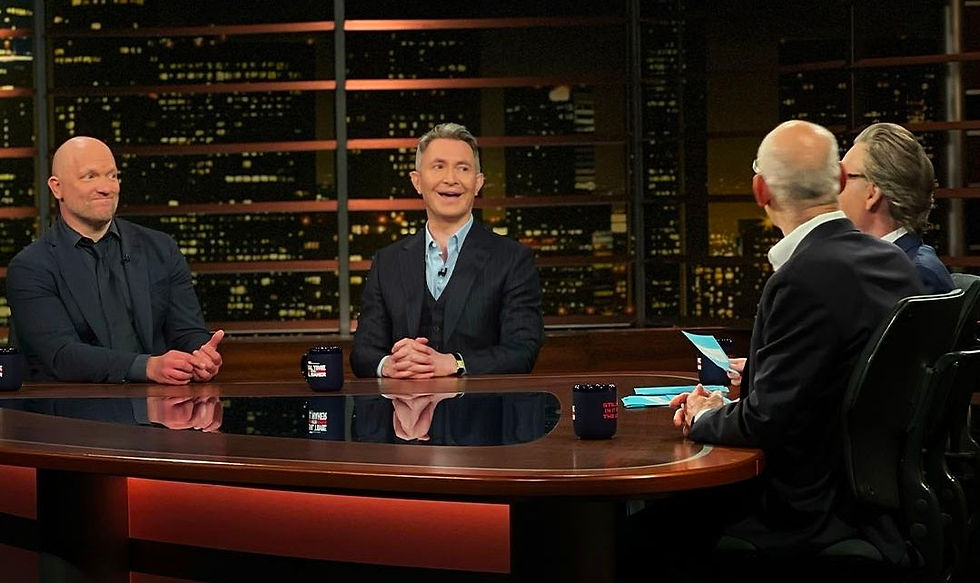
I’m doing laundry this morning, watching Real Time with Bill Maher (don't ask me why, it's become part of my routine), half-paying attention, and then Maher opens the panel with that line—“just three white guys talking about going to war”—and I actually pause the TV.
Because he knows.
He knows exactly how absurd it is. He hears it. He says it out loud. And then...his goofy a— just keeps going.
That’s the part that gets me.
Because once you acknowledge the absurdity—once you admit that this is a detached, insulated conversation about life-and-death decisions—you don’t get to just roll past it like it’s a throwaway joke. You either challenge it...or you become it.
And won't you know, that b–h a— h–nky became it. A whole Chickensh–t.
Within minutes, Maher and this English twat, Douglas Murray, are talking about Iran like its intentions are settled fact. Not debated. Not uncertain. Not contingent. Settled. The implication is clear: Iran wants nuclear weapons. Of course they do. Everybody knows it. Why are we even pretending otherwise?
And I’m sitting there thinking—no. That’s not how this works. Ali Khamenei forbade the development of nuclear weapons and decreed a literal FATWA against the use and development of nuclear weapons.
I don’t buy the leap. I don’t buy their smug confidence. I don’t buy the way “they have uranium enrichment capability” quietly mutates into “they’re obviously building a bomb.” Those are not the same thing. Not technically. Not politically. Not strategically. THERE'S IS NO EVIDENCE IRAN WAS BUILDING A NUCLEAR BOMB. NONE.
But they say it like there is.
And that’s the trick, right? Anybody who’s seen this kind of conversation before knows the move: you compress the uncertainty, you skip the qualifiers, you smooth out the complexity until what’s left feels obvious. I’ve seen it in boardrooms, I've seen it in kitchens, I’ve seen it in classrooms, I’ve seen it in rooms where people are way too comfortable making decisions about things they don’t fully understand.
Same pattern. Different stakes.
Because here’s the reality they glide past: uranium enrichment is not some singular, sinister pathway that only leads to a bomb. It’s a spectrum of scientific processes with civilian applications—energy production, medical isotopes, research infrastructure. That’s not fringe knowledge. That’s baseline.
But Maher doesn’t engage that. Murray doesn’t engage that. They don’t sit in the nuance at all. They jump straight to intent.
“They want a nuke.”
Based on what? A feeling? A posture? A narrative Netanyahu's been pushing longer than I've been born that got him banned from the state department under the first Bush's presidency?
That’s not analysis. That’s assumption dressed up as certainty.
And once that assumption is in place, everything that follows gets easier. Preemption starts to sound logical. Aggression starts to sound defensive. You can feel the conversation leaning towards outright Islamophobia —subtly, but unmistakably.
And here’s where it crosses a line for me.
Because they’re not just getting a technical detail wrong. They’re setting up a chain reaction. If you convince people that a country has already made the decision to build a nuclear weapon, then the moral calculus shifts. Now it’s not if you act—it’s when. And how hard.
Let’s not pretend we don’t know what that leads to.
20 years of sending young men and women to die and no stable democracy in the Middle East to show for all of our efforts. Civilian infrastructure decimated. Children orphaned. Another country in the region left in the hands of, perhaps, an even more volatile regime.
That’s what’s sitting underneath their certainty.
And what’s wild is that Paul Reickhoff, a veteran, was the only person at that table who seems grounded in that reality.
He doesn’t let it slide. He pushes back. Not theatrically, not for applause—just like someone who’s actually had to live with the downstream effects of these conversations. He resisted the flattening. He slowed it down. He forced the conversation back into something resembling reality, at least.
That matters more than people realize.
Because without that interruption, the whole segment becomes an echo chamber of confident bullsh–t. No friction. No correction. Just a steady escalation of a premise that was never fully proven to begin with.
And here’s the part that really locks it in for me—the pattern.
Because later, Maher shrugs off Artemis II like it’s pointless. Like the Moon is just another rock, another expensive distraction, nothing of real value. And I’m sitting there thinking...it’s the same exact instinct.
He doesn’t understand the full scope of uranium enrichment, so he reduces it to its most alarming version.
He doesn’t understand the full scope of Artemis II—its role in advancing deep-space capability, engineering systems, long-term exploration infrastructure—so he reduces it to a punchline.
Different subjects. Same move.
Flatten. Dismiss. Speak with confidence anyway.
And that’s the problem.
Because when you do that with space exploration, you just sound uninformed. When you do that with nuclear policy, people die.
It's okay to shut the f–ck up sometimes.
So no—I’m not going along with the Zionist propaganda. I’m not accepting that kind of casual certainty about something this serious. I’m not letting “they want nukes” slide as if it’s an established fact when it’s not.
Because once you start treating assumptions like conclusions, the consequences stop being hypothetical.
They become real.



Comments