San Diego, White Nationalism, and the Dangerous Myth That Only One Community Is Under Siege.
- reignitedtheseries
- May 21
- 5 min read

"Three Muslim men were murdered outside a mosque in San Diego, and the reaction revealed more than the attack itself. Why white nationalism fuels both Islamophobia and antisemitism—and why institutions struggle to admit it."
by Ken Oswald "__yak" Vann, Jr.
Thursday 21 May 2026
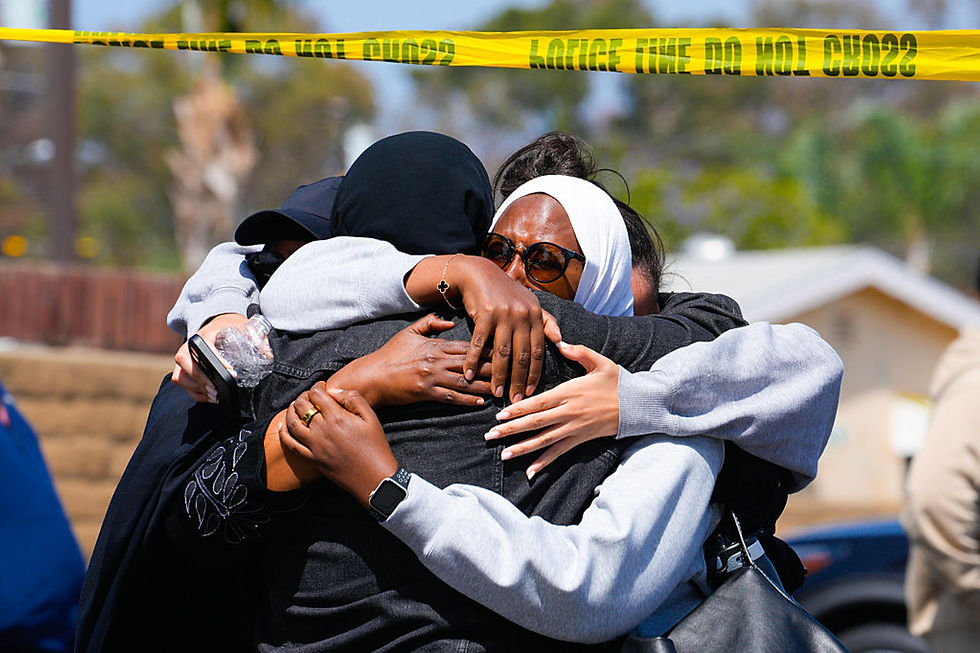
Three Muslim men get murdered outside a mosque in San Diego and watch how fast the conversation starts bending itself into pretzels to avoid saying the obvious.
We all know this isn’t really about “rising extremism.” It’s not about some mysterious epidemic of random hatred floating through society like a sneaky fart. It’s about which kinds of victims the Western media ecosystem is comfortable centering, who they're comfortable minimizing, and which political narratives are too useful to disrupt.
That’s the actual story.
Amin Abdullah. Mansour Kaziha. Nadir Awad.
Three Muslim men dead outside the Islamic Center of San Diego. One of them, Amin Abdullah, reportedly died trying to lock the place down while children hid inside. And somehow—even after Christchurch, Quebec City, London Ontario, Bærum, all of it—we still act shocked every single time anti-Muslim violence erupts out of the exact same ideological pipeline.

Like at some point we have to stop pretending this is random acts carried out by "lone wolves".
The media keep framing these attacks like they’re isolated glitches in democracy when they’re actually downstream consequences of years of narrative conditioning. You spend a decade telling people Muslims are invaders, migrants are replacing Western civilization, refugees are dangerous, birth rates are warfare, borders are collapsing, Europe is being “taken over”… then everybody suddenly clutches pearls when some terminally-online idiot decides he’s defending civilization with a rifle.
Lol. What exactly did people think was going to happen?

This is what makes the media framing so dishonest. You’ll get endless think pieces, panels, emergency language, institutional statements, and political theater whenever antisemitism spikes—and to be clear, antisemitism is real, violent, and absolutely rising in parts of the West. That’s not even debatable. But when Muslims are targeted, the framing suddenly becomes softer, foggier, less structural. More “tragic incident” than ideological emergency.
And that imbalance matters because it hides the actual engine driving a huge percentage of both anti-Muslim and antisemitic attacks in the West: white nationalism.
That’s the part nobody wants to sit with too long because once you follow the trail honestly, it starts leading into mainstream political discourse, immigration rhetoric, media incentives, and Western identity politics—not just fringe Telegram channels with anime avatars and swastikas in the bio.
The same ecosystem telling people Muslims are invading Europe is usually the same ecosystem telling people Jews are orchestrating the invasion. That’s why so many of these attackers overlap ideologically. Same forums. Same replacement theory garbage. Same demographic panic. Same “civilization under siege” fantasy.
It’s basically conspiracy DLC.

Swap out a few nouns, add a manifesto, throw in some race science and YouTube algorithms, and now you’ve got another kid trying to speedrun societal collapse because he thinks he’s starring in the final season of Whiteworld, and meanwhile institutions keep responding to the symptoms while protecting the narrative infrastructure creating the disease.
Because anti-Muslim panic has become politically profitable. That’s the uncomfortable truth underneath all this.
You cannot spend years mainstreaming language about “invasions,” “replacement,” “real Americans,” “European bloodlines,” “protecting the West,” and “taking our country back,” then act confused when violence follows. That’s like sticking your dick in a truck stop glory hole, raw, then acting stunned when your dick is on fire.

Once fear of Muslims becomes normalized politically, it doesn’t just stay contained to campaign slogans or Fox News segments or TikTok edits with dramatic music over border footage. It starts shaping policy. Stricter immigration laws. Refugee crackdowns. Mass surveillance. Citizenship paranoia. Expanded policing. Detention regimes.
Internationally, the same fear ecosystem gets folded into foreign policy.
We're supposed to pretend these conversations exist in separate boxes, but they don’t.
The political environment that aggressively centers antisemitism while minimizing Islamophobia also creates cover for increasingly hardline pro-Israel policy frameworks across the West. Criticism of Israeli state violence gets collapsed into extremism faster than anti-Muslim rhetoric gets recognized as radicalization. Anti-BDS laws get treated like moral necessities while anti-Muslim hate gets handled like an unfortunate social side effect nobody can fully explain.

For twenty years the West built counterterrorism policy around Muslims while white nationalist networks were quietly becoming the dominant domestic terror threat. That’s not irony. That’s incentive.
Universities and corporations are quick to issue statements condemning antisemitism after October 7, while often remaining slower or more cautious publicly addressing anti-Muslim attacks and Islamophobia spikes. Congressional hearings have no problem heavily focusing on campus antisemitism while comparatively little national political attention was devoted to addressing the rise of white nationalism and anti-Muslim hate spikes after Gaza escalation.
Again—none of this means antisemitism isn’t real. It is. Synagogue attacks are real. Neo-Nazi movements are real. Jewish communities are absolutely being targeted.
But pretending Muslims are not also living under a sustained atmosphere of normalized hostility is dishonest.

And to be perfectly frank, the selective empathy is what radicalizes people further.
Because when communities see their dead treated like temporary inconveniences instead of symptoms of a larger political sickness, trust collapses. People stop believing institutions actually care about protecting them. They start seeing the hierarchy in real time—whose fear gets institutional urgency and whose fear gets a brief news cycle before everybody moves on.
That’s why San Diego matters beyond San Diego.
Not just because three Muslim men were murdered outside a mosque. But because the reaction exposed the same pattern we keep seeing over and over again: everybody wants to condemn the violence while protecting the narratives that keep manufacturing it.

And until Western societies are honest about white nationalism being a central ideological driver behind both anti-Muslim and antisemitic violence, this cycle is going to keep repeating itself.
Different city. Different victims. Same pipeline.
That’s not a contradiction.
That’s the whole game.


Comments